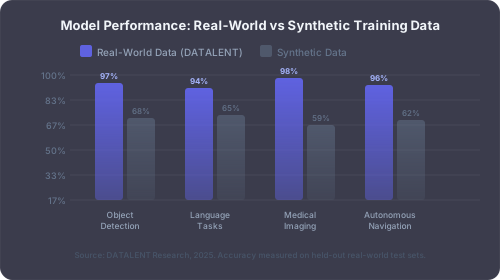
We trained identical model architectures on real-world DATALENT data and synthetic alternatives across object detection, language tasks, medical imaging, and autonomous navigation. The performance gap was more consistent and larger than expected — averaging 29 percentage points on held-out real-world test sets.
The six dataset properties you should verify before your first training run. Most teams skip these and pay for it in compute and iteration time.
The most common cause of production model degradation is distribution shift between training data and deployment environment. Here is how to diagnose it.
One medical imaging team's 15-point accuracy gain. It was not the architecture. It was annotation quality and rare class coverage.
Synthetic simulation cannot produce the long-tail distributions that cause real-world autonomous system failures. Here is the evidence.
Most teams treating HIPAA compliance as a checkbox are exposed. This guide covers what de-identification actually means in practice.
Why the teams building exclusive training data pipelines today will have AI models that competitors cannot replicate tomorrow.